PROCESS

ABOUT LEE POWELL (KENY)

Lee Powell is an Australian painter, writer, and systems-builder whose work sits at the intersection of collapse, reconstruction, and identity.

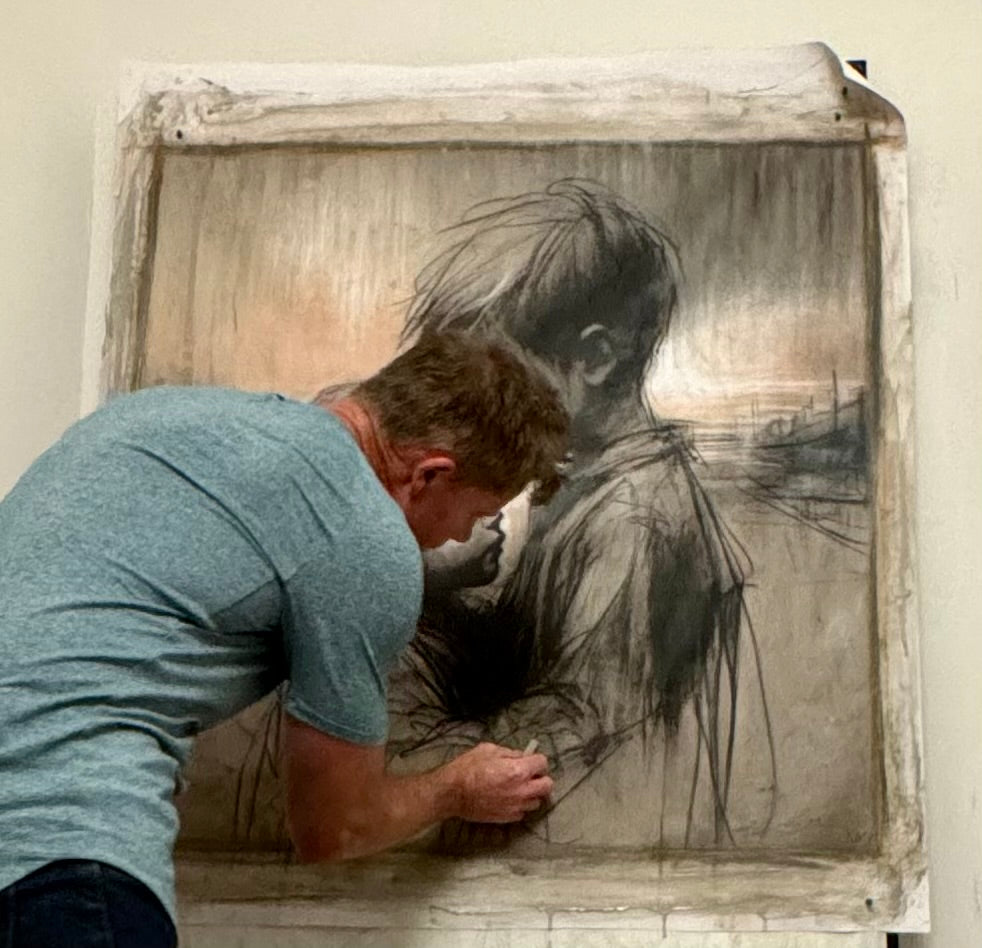
Painting arrived for him at a breaking point — not as a career move, but as a way back to himself. What began as an act of survival grew into a practice of presence. The layers, erasures, fractures, and buried markings that define his work mirror the internal excavation he walked through.

Keny — his artistic pseudonym — is the unfiltered side of Lee. The one who paints without permission. The one who lets instinct speak before logic interferes. Lee, the engineer and founder who built Scrivener for Windows and studied at Oxford, brings structure, discipline, and inquiry.

Together they form the tension in his paintings: the system and the soul learning how to coexist.

His newest body of work, The Excavation Method™, is where that convergence becomes clearest. Each canvas behaves like a discovered artifact — layered, weathered, excavated — revealing traces of the hidden, the forgotten, and the parts of the self we only meet when life breaks us open.

Alongside his art, Lee is the creator of ManOS: Rebuild the Man Beneath the Mask, a movement dedicated to values, presence, and transformation. Both practices come from the same root question:

What does it mean to rebuild a life from scar tissue and emerge more whole than before?

Lee lives and works in Melbourne, creating paintings, writing, and developing ManOS as an evolving system of inner renewal and creative expression.

Explore the work.

Read the book at getmanos.com.

2025 Archibald Prize Entry

I’ve sought to capture the delicate interplay between shadow and light—both the literal contrasts on the canvas and the metaphorical ones within our inner world. The left half of the self-portrait, cloaked in darkness with lunar references, reflects the deep, often unspoken realm of one’s past fears and inherited beliefs. On the right, the canvas opens into a subtler brightness and hidden celestial hints, suggesting the gradual emergence of hope and renewed identity.

Running down the center is a translucent gold seam that speaks to the idea of embracing imperfections and scars, reminiscent of the kintsugi tradition where cracks are mended with precious metal. It is a quiet reminder that we are, in essence, the sum of our experiences—both painful and illuminating. Over the heart, I’ve shaped a lion-flower motif in soft crimson tones, symbolizing courage and growth. This abstracted “lion heart” underscores the conviction that, when nurtured, even the wildest parts of ourselves can flourish into something both powerful and gentle.

I approached this piece as a personal excavation—an exploration of identity, resilience, and the unfolding journey of self-discovery. Yet I hope it remains open to broader interpretation; each viewer may see in it a reflection of their own triumphs, vulnerabilities, and yearnings. At its core, Eclipse of Self speaks to the quiet transformations we undergo when we dare to face our limitations with honesty and emerge with an expanded sense of who we can become.

Historically, the Archibald Prize honors portraiture that not only captures a likeness but resonates with genuine narrative. My intention here is to present a moment in time—a liminal space where darkness and light meet—inviting others to consider the possibility that within our fractured layers, something vital can always take root and grow.

By weaving together these subtle symbols—the whisper of celestial bodies, the gold seam of renewal, and the lion-flower heart of courage—I’ve aimed to create a portrait that offers both personal truth and universal reflection, allowing each viewer to find a part of their own story in its unfolding.

Archibald Entry 2024 - in honour of a good mate, mentor and great Australian Artist - John 'Mort' Murray. 2m by 1m.